President Donald Trump‘s approval rating is showing signs of recovery, marking a potential turning point after weeks of political turbulence and economic uncertainty.
Why It Matters
Recent weeks have seen Trump’s approval ratings plummet amid anxiety about the impact of his Liberation Day tariffs, which saw markets temporarily crash before bouncing back days later.
But after a sharp decline driven by economic anxiety, a recovery in his numbers suggests the president may be stabilizing his base and regaining control of the political narrative.
If the trend continues, it could bolster Republican momentum, complicate Democratic strategy, and reignite fears among Trump critics about the durability of his influence.
President Donald Trump‘s approval rating is showing signs of recovery, marking a potential turning point after weeks of political turbulence and economic uncertainty.
Why It Matters
Recent weeks have seen Trump’s approval ratings plummet amid anxiety about the impact of his Liberation Day tariffs, which saw markets temporarily crash before bouncing back days later.
But after a sharp decline driven by economic anxiety, a recovery in his numbers suggests the president may be stabilizing his base and regaining control of the political narrative.
If the trend continues, it could bolster Republican momentum, complicate Democratic strategy, and reignite fears among Trump critics about the durability of his influence.
What To Know
According to Newsweek‘s tracker, Trump’s approval rating is ticking back up. It is currently standing at 45 percent, while 49 percent disapprove.
Last week, Trump’s approval rating stood at 44 percent, while his disapproval was firmly in the 50s.
It comes as Trump’s approval ratings have been in decline since the announcement of his “Liberation Day” tariffs. The sweeping move roiled the markets, triggering an immediate sell-off that was followed by a rebound days later when Trump implemented a 90-day pause on most of the tariffs.
But the president’s handling of the situation left voters feeling uneasy, with polls reflecting a dramatic erosion of public confidence in his handling of his job over the past few weeks.
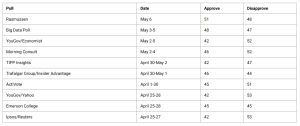
For example, in ActiVote’s latest poll, Trump’s approval rating stood at 45 percent, while 51 percent disapproved, giving the president a net approval of -6 points. ActiVote’s March poll showed Trump with a net approval rating of -1 point, with 48 percent approving and 49 percent disapproving.
And in the latest YouGov/Yahoo poll, conducted April 25-28 among 1,597 respondents, his approval dropped from 44 percent in March to 42 percent, while disapproval rose from 50 percent to 53 percent, widening his net negative from –6 to –11. The poll had a margin of error of ±2.9 percentage points.

President Donald Trump speaks at the White House on May 6, 2025. Mark Schiefelbein/AP
Emerson College also released a poll last week, which showed that Trump’s approval rating had dropped marginally, from 47 percent to 45 percent, since March, while his disapproval rating remained the same at 45 percent. The most recent poll was conducted April 25-28 among 1,000 registered voters and had a margin of error of +/- 3 percentage points.
Meanwhile, Big Data Poll’s latest survey, conducted between May 3 and 5 among 3,128 registered voters, showed that Trump’s approval rating currently stands at 48 percent, down from 56 percent in January, while 47 percent disapprove of his handling of the presidency—up from a record low 37 percent in January.
But some polls are now showing signs that the president’s popularity is recovering.
According to the latest TIPP Insights poll, conducted between April 30 and May 2 among 1,400 adults, Trump’s net approval rating is at -5 points, with 42 percent approving and 47 percent disapproving. That is up from a net -7 point approval rating in early April, when 43 percent approved and 50 percent disapproved. The latest poll had a margin of error of +/- 2.7 percentage points.
But polls show that Trump’s net approval has not changed much since mid-April, suggesting that while the president may not necessarily be becoming more popular, he is not becoming any less popular than he was when his tariffs were first announced.
In the latest poll conducted by Morning Consult between May 2 and 4 among 2,263 registered voters, Trump’s approval rating remained unchanged at 46 percent, but his disapproval rating dropped from 54 percent to 52 percent. The poll had a margin of error of +/- 2 percentage points.
The latest Reuters/Ipsos poll showed his net approval unchanged at -11 points. According to YouGov and The Economist, his approval rating lingers at -10 points.
The latest RMG Research poll, conducted between April 23 and May 1 among 3,000 registered voters, put Trump’s approval rating at +1 point, with 49 percent approving and 48 percent disapproving. That is unchanged from April 24.
But Thomas Gift, an associate professor of political science and director of the Centre on US Politics at University College London, told Newsweek that while Trump’s approval ratings may be improving and are unlikely to fall below the lows seen during earlier tariff-related market turmoil, he risks another dip unless he starts announcing trade deals soon.
“He needs to start announcing trade deals—and fast,” Gift said.
He also warned that Americans may tolerate short-term economic pain for now, but “if the 90-day pause period expires, and voters begin to see the tariffs burn a hole in their wallets, their patience may soon run thin.”
Meanwhile, Democratic pollster Matt McDermott said that small shifts in the numbers that we are seeing in the polls are just “statistical noise,” not signs of growing support.
“What we’re seeing is stagnation, not momentum,” he said.
He warned that the economic pain from Trump’s tariffs is just beginning, with companies like Mattel, Microsoft, Procter & Gamble, and Ford all announcing price hikes. “You can’t gaslight voters into believing things are fine when the cost of everything from diapers to pickup trucks is going up.
“Trump is hoping to shift blame for a weakening economy, but it’s not going to work. Voters know exactly who’s responsible,” he said.
How Donald Trump’s Approval Rating Compares to First Term
Polling average for May 7 2025/2017
 A Flourish chart
How Donald Trump’s Approval Rating Compares to First Term
The RealClearPolitics tracker showed that on May 7, 2017, Trump’s approval rating was 44 percent, while his disapproval rating was 51 percent. This gave him a net approval rating of -7 points, making Trump marginally more unpopular now than at the same point in his first stint in the Oval Office.
How Donald Trump’s Approval Rating Compares to Joe Biden’s
Trump’s 45 percent approval rating is lower than that of former President Joe Biden at the same point in his presidency. On May 7, 2021, Biden stood at 54 percent, with a disapproval rating of 42 percent, according to RealClearPolitics.
While Trump began his second term with his highest approval ratings to date, according to Gallup’s first poll of Trump’s second term, conducted between January 21 and 27, he was still less popular than any president since 1953 at the start of a term and the only one to begin with a sub-50 percent approval rating. Gallup said Biden started his first term with a 57 percent approval rating.
And according to data compiled from Gallup by The American Presidency Project, Trump ranks far below other recently elected presidents after 100 days, dating back to Eisenhower, who had an approval rating of 73 percent.
Other recently elected presidents saw higher approval ratings at the 100-day mark, including: John F. Kennedy, 83 percent; Richard Nixon, 62 percent; Jimmy Carter, 63 percent; Ronald Reagan, 68 percent; George H.W. Bush, 56 percent; Bill Clinton, 55 percent; George W. Bush, 62 percent; and Barack Obama, 65 percent.
What People Are Saying
Thomas Gift told Newsweek: “It would be hard for Trump’s approvals to dip lower than the nadir he faced after Wall Street tumbled in response to his tariffs. But for Trump to avoid snapping back to that low point, he needs to start announcing trade deals—and fast. Many Americans may be willing to give Trump the benefit of the doubt as he tries to reassure voters that short-term pain will result in long-term gain. However, if the 90-day pause period expires, and voters begin to see the tariffs burn a hole in their wallets, their patience may soon run thin.”
Matt McDermott told Newsweek: “There’s no question Trump has a hardened base that props up his floor — but nothing in the data suggests he’s on solid ground beyond it. Even his “best” polls have him significantly underwater with the broader electorate. A couple points of statistical noise doesn’t mean voters are embracing Trump’s chaos. What we’re seeing is stagnation, not momentum.
“The real problem for Trump is that the economic pain from his tariffs is just beginning to hit. This isn’t a one-day story, it’s a slow burn. Just this week alone Mattel announced price increases on toys, Microsoft hiked prices on consumer electronics, Procter & Gamble warned of higher costs for household staples, and Ford said it’s raising car prices this summer.
“Every headline about rising prices is going to serve as a reminder to voters that Trump is dragging down the economy. You can’t gaslight voters into believing things are fine when the cost of everything from diapers to pickup trucks is going up.
“The latest YouGov/Economist poll shows 55 percent of registered voters blame Trump for today’s economy; while just 31 percent blame Biden. That’s devastating. Trump is hoping to shift blame for a weakening economy, but it’s not going to work. Voters know exactly who’s responsible.”
Big Data Poll Director Rich Baris: “This dramatic of a decline is not entirely surprisingly given our last quarterly survey measured President Trump during the honeymoon phase of his second term. But all honeymoons come to an end, and it’s safe to say this one has, as well.”
“Party loyalty has a habit of regaining strength and concerns replace optimism.”
What Happens Next
Trump’s approval rating could fluctuate in the coming weeks, depending on the outcome of key events, including critical negotiations in the Russia-Ukraine war, the evolving tariff situation and concerns about a recession.
Update 5/07/25, 11:20 a.m. ET: This article has been updated with comment from Thomas Gift and Matt McDermott.