Pensacola Bay’s Funny Little Finds: The “Sea Turd” Explained
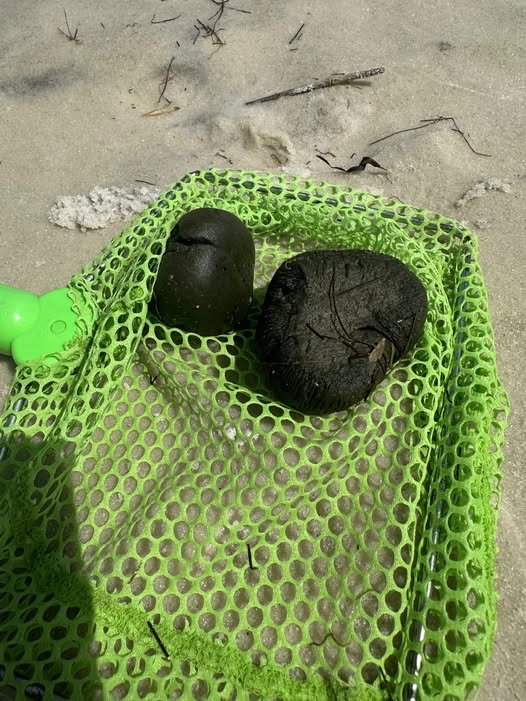
If you have ever spent time along Pensacola Bay with children, chances are you have heard the joyful laughter and dramatic announcements. “Look what I found. A sea turd.” While the name is enough to make adults laugh, the strange little objects being proudly displayed are actually a natural coastal phenomenon known as mudballs. These curious orbs are a familiar sight to locals and visitors alike, and they hold a fascinating story about how the bay itself shapes its shoreline.
Mudballs appear most often along shallow edges of the bay, near sandy flats and grassy marshes where the bottom is made of soft, clay rich sediment. At first glance they seem like something unusual or even suspicious, but they are simply part of the landscape. They sit quietly among shells and sea grass, waiting for the next young explorer to discover them.
Despite the silly nickname, mudballs are not manmade and they are not waste from marine life. They are a natural result of water movement and soft sediment. Pensacola Bay’s underwater floor contains thick layers of fine mud mixed with organic matter from plants and tiny marine organisms. Over time, waves, tides, boat traffic, and even human footsteps loosen small chunks of this mud from the seabed.
Once a piece breaks free, the water takes control. The fragment begins to roll and tumble along the bottom, pushed by currents and gentle wave action. As it moves, sand and silt polish its surface. Corners soften. Edges round out. What begins as an irregular lump slowly transforms into a smooth, compact sphere. This process is very similar to how rough stones become rounded pebbles in rivers or how sea glass becomes smooth after years of tumbling in the surf.
The finished result is a firm but squeezable ball of mud that feels almost like modeling clay. The color often ranges from deep green to nearly black, depending on the amount of organic material inside. That dark color sometimes leads people to wonder if the object might be tar, oil, or something unpleasant. In most cases, it is none of those things. It is simply nutrient rich bay mud, formed naturally and safely.
Mudballs generally have no strong odor and leave little to no residue on the hands. If one ever smells unusual, feels sticky, or leaves an oily film, it should be discarded and hands should be washed. But the typical Pensacola Bay mudball is harmless and perfectly safe to examine, roll, and even keep for a short time before returning it to the shore.
For many Gulf Coast families, collecting these strange little finds has become a childhood tradition. Children line them up on the sand, compare sizes and shapes, and proudly carry them like trophies. In doing so, they unknowingly begin to learn about tides, erosion, and the quiet power of moving water.
These simple discoveries often become treasured memories. Long after the shells are lost and the sand washed from shoes, stories of the day someone found the biggest “sea turd” on the beach still bring laughter. Mudballs may never appear in museums or guidebooks, but they hold an important place in coastal life. They remind us that nature is full of surprises, that learning can happen through play, and that even the strangest little objects can create lasting joy.
So the next time your child comes running up with a muddy treasure from Pensacola Bay, you will know exactly what it is. A perfect little mudball, shaped by the bay itself, waiting to become part of another coastal childhood story.