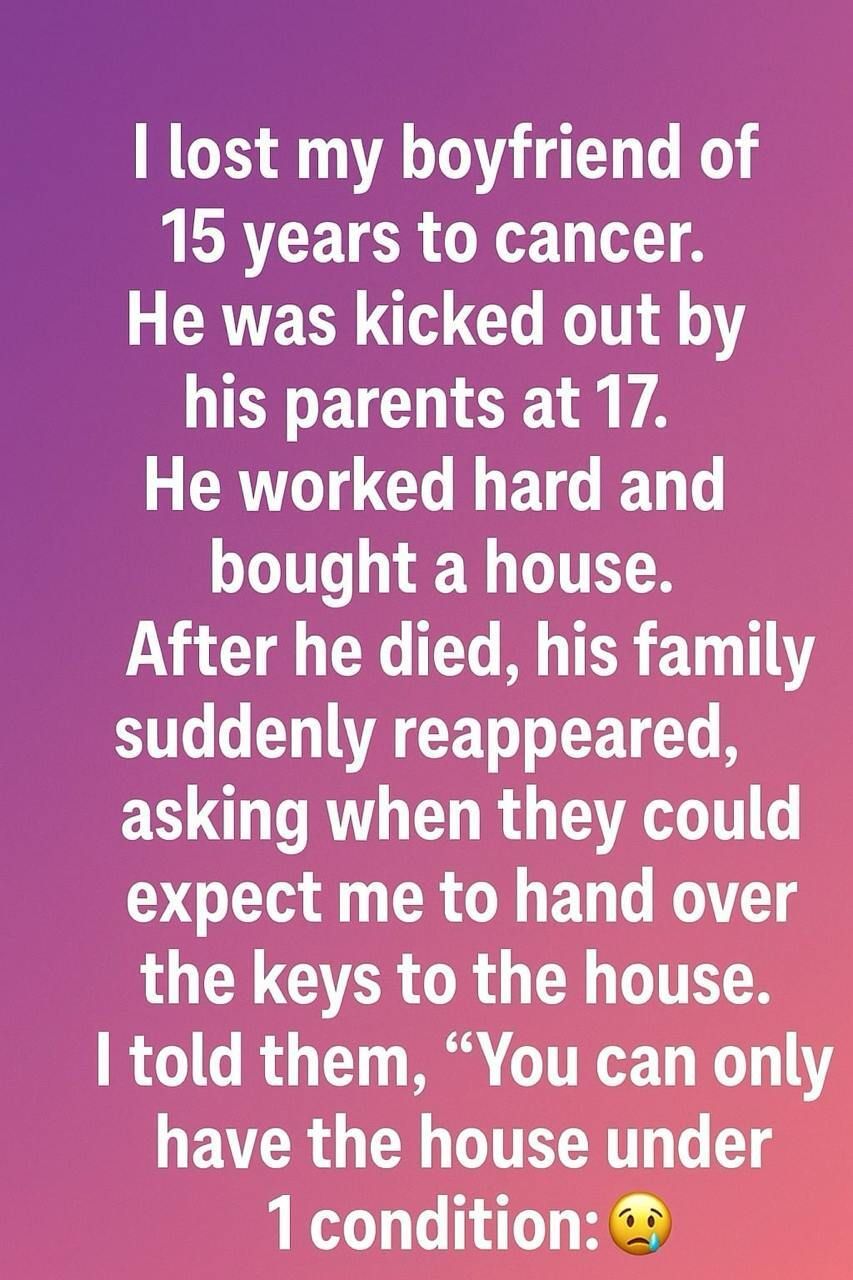
When my partner of fifteen years passed away, it felt as though the ground beneath my feet had vanished. He wasn’t just the man I loved — he was the one who stood beside me through every season of life. Losing him meant losing my best friend, my confidant, and the quiet comfort of knowing I wasn’t walking through the world alone.
Long before we met, life had already tested him. At seventeen, he had been asked to leave his family home, forced to build a life entirely on his own. But instead of letting bitterness define him, he poured his energy into work, saving every dollar he could.
In time, he accomplished something remarkable: he purchased a small house, modest but full of possibility. He once told me it was the first place that ever truly felt like his.
Together, we turned that house into a home. Weekend projects, freshly painted walls, mismatched thrift-store furniture, and evenings filled with laughter stitched our lives into the space. Even during difficult times, he would take my hand and say, “One day, this home will be our forever.”
When he died, I clung to that promise. The house wasn’t just a structure — it was a symbol of everything he overcame and everything we built side by side.
Which is why, when his family showed up just weeks later, asking when I planned to hand over the keys, I felt something inside me shatter.
They had been absent from his life for years. There had been no phone calls, no reunions, no attempts at reconciliation.
The quiet of their absence was something he carried with him, even when he rarely spoke of it. Seeing them now, standing in the doorway of the home he poured his love into, stirred emotions I wasn’t ready to face.
At first, I didn’t know what to say. My grief was still raw, and the thought of losing the only physical piece of him I had left felt unbearable. But I also knew that anger wouldn’t honor the man he had been.
So I stepped aside, took a breath, and spoke gently.
“You can have the house,” I said. “But only on one condition: that you treat it with the same love and kindness he put into it. This place was his heart. If you want it, you must protect what it meant.”
The room fell silent. I half expected them to argue, or to insist on legalities, or to turn cold. But instead, something softened unexpectedly.
His mother’s eyes filled with tears.
She sat down slowly, as if the weight of years had finally caught up with her. “I made mistakes,” she whispered. “Mistakes I was too proud to fix. He deserved better from us. I wish I’d said it while I could.”
Her honesty broke something open in the room. All the resentment, all the distance, all the unspoken regret — it was suddenly visible, gently laid out between us.
We ended up sitting in the living room — the very room where he used to curl up with a book or play music on quiet nights. For hours, we shared memories: funny stories, childhood moments, things we each loved about him. The grief became softer as we talked, almost transforming into gratitude for the time each of us had with him.
By the time the sun began to slip behind the trees, the heaviness in the house had changed. It wasn’t just mine to carry anymore.
They didn’t take the house that day. They didn’t demand anything. Instead, they left with something far more meaningful — a connection to the son they had lost and a renewed understanding of what he had built.
And I realized something, too.
Forgiveness doesn’t erase pain, but it opens the door to healing in ways I never expected. The home still holds his memory in every corner, but it no longer feels like a lonely monument. It feels warmer, gentler — as if the love he wanted in this place finally found its way back.